

Abstract
The management of waste generated from metallurgical processes presents a significant operational and environmental challenge for the global metals industry. Metallurgical sludge, a byproduct rich in heavy metals, water, and process chemicals, requires specialized handling to mitigate environmental risks and comply with stringent international regulations. This analysis examines the critical role of modern metallurgical sludge removal systems in achieving efficient solid-liquid separation. It focuses on the principles, technologies, and selection criteria for these systems, with a particular emphasis on the filter press as a predominant technology. The discussion explores the intricate process of sludge characterization, the comparative efficacy of various dewatering methods, and the specification of key system components such as filter plates and cloths. The objective is to provide a comprehensive framework for industrial operators to navigate the complexities of selecting and implementing a system that not only ensures regulatory compliance but also enhances operational efficiency, reduces disposal costs, and potentially facilitates the recovery of valuable materials from the waste stream.
Key Takeaways
- Thoroughly analyze your sludge's chemical and physical properties before choosing a system.
- Filter presses often provide the highest cake dryness, reducing disposal volume and costs.
- Match the filter plate and cloth material to your sludge's specific characteristics for longevity.
- Consider automation levels to balance initial investment with long-term labor savings.
- Partner with a manufacturer experienced in metallurgical sludge removal systems for best results.
- Proper system sizing is crucial; base it on accurate sludge volume and solids content data.
- Evaluate after-sales support and spare parts availability for long-term operational reliability.
Table of Contents
- Step 1: Characterize Your Metallurgical Sludge
- Step 2: Evaluate Available Sludge Removal Technologies
- Step 3: Define Your Operational and Performance Requirements
- Step 4: Specify Key System Components for Optimal Performance
- Step 5: Partnering with the Right Manufacturer and Supplier
- Frequently Asked Questions (FAQ)
- Conclusion
- References
Step 1: Characterize Your Metallurgical Sludge
The journey toward an effective and efficient metallurgical sludge removal system does not begin with machinery catalogs or sales discussions. It begins with a deep, almost intimate, understanding of the waste material itself. To treat a substance, one must first know it. Metallurgical sludge is not a uniform material; it is a complex and highly variable cocktail, a direct reflection of the specific processes from which it originates. A steel mill's pickling line sludge will be vastly different from the effluent treatment sludge of a zinc plating facility. Therefore, the first and most foundational step is a meticulous characterization of your sludge. This is not a mere formality; it is the bedrock upon which all subsequent decisions—from technology choice to component material—will be built. Neglecting this step is akin to a physician prescribing medication without a diagnosis; the results are likely to be ineffective at best and detrimental at worst.
Understanding Sludge Composition: The Foundation of Selection
The chemical makeup of your sludge dictates its hazardous nature, its potential for resource recovery, and the materials that can safely be in contact with it. A comprehensive laboratory analysis is non-negotiable. This analysis should identify and quantify several key components. First, the heavy metals present, such as chromium, nickel, zinc, copper, lead, and cadmium, are of primary concern due to their toxicity and the stringent regulations governing their disposal. Knowing their concentrations is vital for compliance. Second, the analysis must determine the pH of the sludge. Is it highly acidic, or is it alkaline? This will have profound implications for the choice of filter cloth and plate materials, as well as any necessary pre-treatment steps. For instance, a highly acidic sludge would rapidly corrode standard steel components and could degrade certain types of polymer-based filter media.
Furthermore, the sludge will contain other process-related contaminants. These can include oils, greases, suspended solids of various kinds, and residual chemicals from the production line. Each of these components affects how the sludge will behave during the dewatering process. Oils can blind the filter cloth, reducing filtration efficiency, while a high concentration of very fine, non-compressible particles can be notoriously difficult to dewater. Think of trying to squeeze water from fine clay versus coarse sand; the latter releases water far more easily. A proper analysis will provide a particle size distribution, giving you a clear picture of whether you are dealing with sand, silt, or clay-like particles.
Quantifying Sludge Volume and Generation Rate
Once you understand what your sludge is, you must determine how much of it you have. This involves quantifying both the total volume generated and the rate of its production. Is your facility producing 10 cubic meters of sludge per week, or per day? Is the generation continuous throughout the operational shift, or does it come in large, intermittent batches? Answering these questions is fundamental to correctly sizing your metallurgical sludge removal system. A system that is too small will create a constant backlog, leading to production bottlenecks and potential non-compliance if storage capacity is exceeded. Conversely, an oversized system represents a significant and unnecessary capital expenditure, consuming more energy and occupying more floor space than required.
To determine these figures, you can use flow meters on effluent lines leading to your treatment plant, measure the fill rate of holding tanks, or conduct a thorough audit of your waste streams over a representative period. It is crucial to account for any variability, such as differences in production schedules between weekdays and weekends or seasonal fluctuations in output. This data on volume and flow rate, combined with the solids concentration from your lab analysis, allows you to calculate the total mass of dry solids that needs to be processed per day. This solids loading rate is the primary metric that engineers will use to size the filter press or other dewatering equipment.
Identifying Physical and Chemical Properties
Beyond the basic chemical composition and volume, the physical properties of the sludge are paramount to predicting its behavior within a dewatering system. Viscosity, or the sludge’s resistance to flow, is a key parameter. A thick, viscous sludge may require more powerful pumps to transfer and may be more challenging to distribute evenly within the chambers of a filter press.
Another critical property is its compressibility. This describes how readily the solid particles within the sludge will compact under pressure to release the entrained water. Some sludges are highly compressible, readily forming a dense, dry cake. Others are "slimy" and non-compressible, tending to extrude and resist dewatering. A simple bench-top test, such as a Buchner funnel test or a capillary suction time (CST) test, can provide valuable insights into the sludge's filterability and compressibility. These tests, while simple, can help predict whether chemical conditioning will be necessary. Chemical conditioning, often involving the addition of polymers (flocculants) or coagulants (like lime or ferric chloride), works by gathering the fine particles into larger, more manageable agglomerates, or "flocs." This process dramatically improves the dewatering rate by creating larger channels within the sludge for the water to escape, much like gathering scattered dust into clumps makes it easier to sweep up. The choice and dosage of these conditioning chemicals are determined through laboratory jar testing, which simulates the process on a small scale to find the optimal recipe for your specific sludge.
Step 2: Evaluate Available Sludge Removal Technologies
With a comprehensive profile of your metallurgical sludge in hand, the next logical step is to survey the landscape of available technologies designed to separate the solid and liquid phases. The primary goal of any metallurgical sludge removal system is dewatering: the removal of as much water as possible from the solid waste. Why is this so important? Consider the economics. Disposal of hazardous sludge is often priced by weight or volume. Since water is heavy and voluminous, removing it directly translates to a drastic reduction in disposal costs. A sludge that is 98% water and 2% solids means that for every 100 tons of waste you dispose of, 98 tons are just water. By dewatering it to a cake of 25% solids (75% water), that same 2 tons of solid waste now only weighs 8 tons in total. That's a disposal reduction of over 90%. Furthermore, the separated water, or filtrate, is often clean enough to be recycled back into the plant's processes, reducing freshwater consumption.
The Dominance of Mechanical Dewatering
Historically, sludge management might have involved large, land-intensive solar drying beds or settling lagoons. While simple, these methods are slow, require a vast footprint, are climate-dependent, and pose a significant risk of environmental contamination through leachate seeping into the ground. In the context of modern industrial operations, where space is a premium and environmental regulations are strict, these passive methods have been largely superseded by active, mechanical dewatering technologies. These systems use mechanical forces—pressure or centrifugal force—to rapidly and efficiently squeeze or fling water out of the sludge in a controlled, contained process. The three most common mechanical systems used in industrial settings are the belt filter press, the centrifuge decanter, and the plate-and-frame filter press. Each has its own operational principle, strengths, and weaknesses, and the optimal choice depends heavily on the sludge characteristics you identified in Step 1.
Comparative Analysis of Dewatering Systems
To make an informed decision, a direct comparison is invaluable. Let's examine these three leading technologies.
A centrifuge decanter operates like a super-charged salad spinner. It uses high-speed rotation to create powerful centrifugal forces that separate the denser solids from the lighter liquid phase. They are continuous systems with a high throughput and a relatively small footprint. However, they can have high energy consumption and maintenance costs due to the high-speed rotating parts. They are also often less effective at capturing very fine solid particles, which can result in a lower quality filtrate, and the final cake is typically not as dry as that from a filter press.
A belt filter press works by sandwiching the sludge between two porous belts and passing them over a series of rollers of decreasing diameter. This gradually increases the pressure on the sludge, squeezing the water out. They are also continuous systems and are generally effective for more fibrous or less compressible sludges. Their capital cost can be lower than other options, but they often produce a wetter cake than a filter press and can have issues with odors and require significant operator attention and wash water.
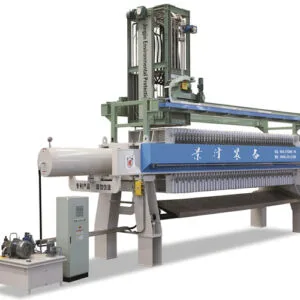
The recessed plate filter press, often simply called a filter press, operates on a batch basis. It uses a powerful hydraulic pump to clamp together a series of plates, forming sealed chambers. Sludge is then pumped under high pressure into these chambers. The liquid passes through a filter cloth lining each chamber wall, while the solids are trapped inside, gradually building up to form a firm, dry cake. As noted by industry experts, the filter press is an intermittent process, but its ability to generate high pressures results in exceptional dewatering performance (Lenntech, 2025).
| Technology | Dewatering Principle | Typical Final Cake Solids | Key Advantages | Key Disadvantages |
|---|---|---|---|---|
| Filter Press | High-Pressure Filtration | 30% – 70% | Highest cake dryness; excellent filtrate clarity; high reliability; lower running costs. | Batch operation; higher capital cost for full automation. |
| Centrifuge Decanter | Centrifugal Force | 15% – 35% | Continuous operation; small footprint; high throughput capacity. | High energy use; high maintenance; may require more polymer; lower cake dryness. |
| Belt Filter Press | Gradual Pressure/Shear | 12% – 30% | Continuous operation; handles fibrous sludge well; lower capital cost. | Lower cake dryness; high water usage for belt washing; potential odor issues. |
For most metallurgical sludge removal systems, the primary goals are maximum cake dryness to minimize disposal costs and high filtrate clarity to meet discharge permits or allow for water reuse. As the table illustrates, the filter press consistently excels in these two areas. The ability to achieve cake solids content of 40%, 50%, or even higher is a decisive advantage that often outweighs the drawback of its batch operation cycle.
Deep Dive into the Filter Press Mechanism
Understanding how a filter press works helps to appreciate its effectiveness. The operational cycle, as outlined by Lenntech (2025), can be broken down into distinct phases:
-
Press Closing: The cycle begins with the empty press. A hydraulic cylinder activates, pushing the "moving head" of the press forward. This action clamps the entire stack of filter plates together, creating a watertight seal between them. The force applied is immense, ensuring that the chambers can withstand the high pressures of the filtration phase without leaking.
-
Filling (Filtration): Once the press is securely closed, a high-pressure feed pump begins to move the conditioned sludge from a holding tank into the press. The sludge enters through a central port and is distributed to all the empty chambers simultaneously. As the chambers fill, the pressure inside begins to rise. This pressure becomes the driving force for separation. The liquid component of the sludge is forced through the microscopic pores of the filter cloth, while the solid particles are too large to pass and are retained on the cloth's surface. The clear liquid, now called filtrate, is collected in channels behind the cloth and piped away.
-
Dewatering (Compaction): As pumping continues, more and more solids accumulate inside the chambers, forming a layer that grows progressively thicker. This layer is the filter cake. The resistance to flow increases, causing the feed pressure to rise further, often up to 15 bar (225 PSI) or more. This immense pressure physically compacts the cake, squeezing out additional water that was trapped between the particles. This high-pressure compaction phase is what allows the filter press to achieve its signature high level of cake dryness. The feed pump typically shuts off once a preset pressure is reached and held, indicating that the chambers are full of compacted solids and no more water can be efficiently removed.
-
Cake Discharge: After the filtration phase is complete, the hydraulic cylinder retracts, opening the press. The filter plates are then separated one by one, either manually by an operator or automatically by a plate shifting mechanism. As each plate moves, the compacted, solid filter cake that has formed on its surface falls out of the chamber, typically onto a conveyor or into a hopper below for disposal. Once all the cakes are discharged, the filter cloth may be automatically washed, and the press is ready to be closed for the next cycle.
A key innovation in this field is the membrane filter press. As described by filtration specialists, this type of press includes special filter plates with a flexible, inflatable membrane on their surface (filterpressequipment.com). After the initial filtration cycle is complete, this membrane is inflated (usually with water or compressed air), exerting a powerful squeeze on the filter cake already formed in the chamber. This secondary squeeze can remove even more residual moisture, often achieving a 10-15% improvement in cake dryness over a standard chamber press and reducing the cycle time.
Step 3: Define Your Operational and Performance Requirements
Having identified the filter press as a likely candidate for your metallurgical sludge removal system, the process now shifts from the general to the specific. It is time to translate your facility's unique needs and goals into a concrete set of performance specifications. This is not a theoretical exercise; it involves defining clear, measurable targets that the new system must meet. These requirements will guide the final design and configuration of your equipment, ensuring it is a perfect fit for your operational reality. This step involves a careful balancing of performance goals, capital investment, and long-term operating costs.
Setting Targets for Cake Dryness and Filtrate Quality
This is perhaps the most critical performance metric you will define. What level of dryness is "good enough" for your filter cake? The answer is driven by economics and regulations. The primary benefit of a drier cake is reduced disposal cost. You should calculate the potential savings for every additional percentage point of solids content. For example, moving from a 30% solids cake to a 40% solids cake doesn't just reduce the water content; it can reduce the total cake weight by nearly 30%. If you are paying hundreds of dollars per ton for hazardous waste disposal, these savings add up very quickly.
Another consideration is whether the cake has any potential for metal recovery. Some smelters or specialist recycling firms may accept filter cakes for reclamation, but they often have minimum solids content requirements. A drier cake is cheaper to transport and more efficient to process, making it a more attractive feedstock for recyclers.
Equally important is the quality of the filtrate. What will you do with the water that is extracted from the sludge? If it is being discharged to a municipal sewer system or directly to the environment, it must meet strict limits on suspended solids, heavy metals, and other contaminants. You need to know your local discharge permit requirements and set the filtrate quality target accordingly. A target of less than 50 parts per million (ppm) of total suspended solids (TSS) is common. If you plan to reuse the water within your plant (for example, in rinsing processes or as cooling tower makeup water), the quality requirements might be even more stringent to avoid damaging equipment or contaminating products. The performance of the filter press, particularly the choice of filter cloth, will directly determine if these targets can be met.
Considering Automation and Labor
Modern metallurgical sludge removal systems, particularly filter presses, are available in a wide spectrum of automation levels. The choice you make here will have a significant impact on both the initial capital cost and your ongoing operational labor costs.
A manual system is the most basic configuration. An operator is required to manually close the press, monitor the feed, open the press, and use a spatula or tool to help dislodge the filter cakes from each chamber. This approach has the lowest initial cost but is highly labor-intensive, can lead to inconsistencies in cycle times, and presents greater potential for worker exposure to the sludge.
A semi-automatic system adds features to reduce the manual workload. This might include an automatic hydraulic system for opening and closing the press and a mechanical plate shifter that automatically separates the plates for cake discharge. The operator's role is reduced to overseeing the process and occasionally intervening if a cake sticks.
A fully automatic system is designed for unattended operation. These systems integrate programmable logic controllers (PLCs) that manage the entire cycle: closing the press, running the feed and membrane squeeze pumps, monitoring pressures, initiating an automatic filter cloth wash, opening the press, running the plate shifter, and confirming cake discharge with sensors. Such systems can run 24/7 with minimal human intervention, providing maximum throughput and operational consistency. While the upfront investment is highest, the reduction in labor costs can provide a rapid return on investment, especially in regions with high labor rates. When making this decision, you must perform a cost-benefit analysis that considers your local labor costs, the number of shifts you operate, and the value of operational consistency.
Footprint, Maintenance, and Utility Needs
Industrial floor space is valuable. Before you can specify a system, you must know where it will be installed and how much space is available. A filter press installation requires more than just the footprint of the press itself. You must account for the area needed to open the press for cake discharge, the space for a cake hopper or conveyor underneath, the location of feed pumps and conditioning tanks, and safe access for operators and maintenance personnel. Be sure to consider vertical height as well, especially if the press is to be installed on an elevated platform to allow for gravity-discharge into trucks or large containers.
Maintenance is another practical consideration. A filter press is a robust piece of machinery, but it requires regular preventative maintenance to ensure reliability. You should discuss the recommended maintenance schedule with potential suppliers. This includes tasks like inspecting the hydraulic system, lubricating the plate shifter mechanism, and, most importantly, periodically replacing the filter cloths. You need to plan for the downtime required for these tasks and ensure you have easy access to all parts of the machine.
Finally, consider the utility requirements. What are the electrical needs for the hydraulic power pack, pumps, and control panel? Is three-phase power available at the proposed location? Does the system require compressed air for certain functions, like valve actuation or a membrane squeeze? Automatic cloth washing systems will require a supply of water. These utility needs must be factored into the total cost of installation and operation.
Step 4: Specify Key System Components for Optimal Performance
With your performance and operational requirements clearly defined, you can now move on to the technical specification of the filter press itself. A filter press is not a monolithic entity; it is an assembly of critical components, each of which must be chosen correctly to handle your specific metallurgical sludge and meet your performance targets. The filter plates create the chamber, the filter cloth performs the separation, and the overall size of the unit determines its capacity. Getting these details right is the difference between a system that works and a system that excels. This phase requires close collaboration with an experienced manufacturer who can guide you through the technical options based on the sludge analysis data you gathered in Step 1.
Selecting the Right Filter Plate
The filter plates are the skeleton of the press. They provide the structure that contains the high-pressure filtration process. They come in different designs and materials, and the choice is not arbitrary.
The two primary designs are the chamber plate and the membrane plate. A standard chamber plate has a recessed surface on both sides. When two plates are pressed together, the recesses form a hollow chamber where the filter cake accumulates. This is the workhorse of the industry, suitable for a wide range of applications (). A membrane plate, as discussed earlier, has a flexible diaphragm that can be inflated after the initial filtration. This secondary squeeze provides the extra dewatering force that makes it a premium choice for applications where maximum cake dryness is the absolute priority. For many difficult-to-dewater metallurgical sludges, the additional investment in membrane plates can be justified by the significant reduction in disposal costs.
The material of the plate is equally important. The vast majority of modern filter plates are made from polypropylene. This polymer is lightweight, chemically resistant to a wide range of acids and alkalis, and relatively inexpensive. For most metallurgical applications, polypropylene is the standard and best choice. However, in some niche applications involving high temperatures (above 80°C) or aggressive solvents that can attack polypropylene, other materials might be necessary. In the past, materials like cast iron were common. While strong and heat-resistant, they are incredibly heavy, brittle, and susceptible to corrosion from acidic sludges. Their use today is limited to very specific, high-temperature industrial processes.
| Plate Design/Material | Primary Application | Key Advantages | Key Disadvantages |
|---|---|---|---|
| Recessed Chamber (Polypropylene) | General purpose, most sludges | Cost-effective, good chemical resistance, lightweight, reliable. | Does not provide secondary squeeze; may result in wetter cake than membrane. |
| Membrane (Polypropylene) | Difficult-to-dewater sludges | Achieves highest cake dryness, shorter cycle times, more efficient washing. | Higher initial capital cost, more complex system. |
| Cast Iron Plate | High-temperature applications | Excellent temperature resistance (over 100°C), very strong. | Extremely heavy, prone to corrosion, brittle, high cost. |
The Critical Role of the Filter Cloth
If the plates are the skeleton, the filter cloth is the heart of the metallurgical sludge removal system. It is the actual filter medium that separates the solids from the liquid. It is a common misconception that the press itself does the filtering; in reality, the press simply provides the structure and pressure, while the cloth does the work. The selection of the right filter cloth is an art and a science, and it has a greater impact on performance than any other single component.
The choice involves three main factors: material, weave, and finish.
Material: The cloth's yarn must be chemically compatible with your sludge. Polypropylene is the most common material due to its excellent all-around chemical resistance (especially to acids and alkalis) and good cake release properties. Polyester may be used in certain solvent or high-temperature applications. Nylon offers excellent resistance to abrasion but is less suitable for acidic conditions. For a typical metal hydroxide sludge, polypropylene is almost always the correct choice.
Weave: The way the yarns are woven together determines the cloth's permeability, particle capture efficiency, and strength. A plain weave is simple and provides good particle capture but can be prone to blinding. A twill weave has a diagonal pattern that offers better flexibility and cake release. A satin weave has a very smooth surface, which provides the best cake release and is resistant to blinding, making it a good choice for sludges with very fine or sticky particles.
Finishing: After weaving, the cloth can be treated to enhance its performance. Heat treatment, or calendering, involves passing the cloth through heated rollers to flatten the yarns and create a smoother, less permeable surface. This improves particle capture and helps the cake release more cleanly.
Choosing the wrong cloth can lead to several problems: poor filtrate clarity (if the pores are too large), rapid blinding or clogging (if the weave is wrong for the particle shape), short operational life (if the material is not chemically compatible), or cakes that are difficult to remove. This is an area where the expertise of your supplier is invaluable. They can recommend a specific cloth based on their experience with similar sludges or by testing samples of your sludge with different cloth types.
Sizing the System: From Lab to Full Scale
The final specification is the size of the press. This is not just its physical footprint, but its filtration capacity. The capacity is determined by two main factors: the total filtration area and the total chamber volume.
Filtration Area: This is the total surface area of all the filter cloths in the press. It is calculated by multiplying the area of a single plate by the number of plates. The required area depends on the filtration rate of your sludge, which is often expressed in units like kg of dry solids per square meter per hour (kg/m²/hr). This rate is determined through the bench-scale testing mentioned in Step 1.
Chamber Volume: This is the total empty volume of all the chambers combined. It determines how much sludge cake the press can hold in a single batch. The required volume is calculated based on the total mass of solids you need to process per day and the number of cycles you plan to run.
Let’s walk through a simplified example. Imagine your plant generates 20 cubic meters (20,000 liters) of sludge per day, and your lab analysis shows it has a 5% solids content.
- Total sludge weight (assuming density of 1 kg/L) = 20,000 kg.
- Total dry solids weight = 20,000 kg * 0.05 = 1,000 kg.
- Your bench testing suggests you can achieve a final cake with 40% solids.
- The total weight of the final cake will be 1,000 kg / 0.40 = 2,500 kg.
- Let's assume the cake density is 1,400 kg/m³. The total volume of cake produced per day will be 2,500 kg / 1,400 kg/m³ = ~1.79 m³.
If you want to process all of this in 8 cycles during a single shift, each cycle must accommodate 1.79 m³ / 8 = ~0.22 m³ of cake. You would therefore need a filter press with a total chamber volume of at least 0.22 m³ (or 220 liters). The manufacturer's technical datasheets will list the chamber volume and filtration area for each of their press models, allowing you to select the one that meets this calculated requirement.
Step 5: Partnering with the Right Manufacturer and Supplier
The journey to acquiring the ideal metallurgical sludge removal system culminates in this final, crucial step: selecting the right company to design, build, and support your investment. The equipment itself, no matter how well-specified, is only one part of the equation. The expertise, reliability, and long-term support of the manufacturer are what transform a piece of machinery into a successful, integrated solution for your plant. This is not a simple transactional purchase; it is the beginning of a long-term partnership. Choosing a supplier based solely on the lowest initial price can be a costly mistake if it leads to poor performance, unexpected downtime, and a lack of support when you need it most.
Evaluating Manufacturer Expertise and Experience
When you evaluate potential suppliers, your first line of inquiry should be about their specific experience with metallurgical sludge. Ask them directly: "How many systems have you installed in plating shops, steel mills, or non-ferrous metal processing facilities?" A general-purpose manufacturer who primarily sells to municipal wastewater plants may not fully grasp the unique challenges of your waste stream. Metallurgical sludges are often more abrasive, more corrosive, and have a more complex chemistry than typical biological sludges.
A manufacturer with deep experience in your industry will understand these nuances. They will know which materials of construction hold up best, which filter cloth weaves are least likely to blind with metallic hydroxides, and how to properly size pumps to handle dense, viscous slurries. Ask for case studies or performance data from installations similar to yours. An experienced supplier will be proud to share their successes. Better yet, ask for references. Speaking directly with an operations manager at another plant who has been running their equipment for several years will provide you with invaluable, real-world insights into the equipment's reliability and the supplier's responsiveness. When you work with a specialist, you are not just buying a machine; you are buying their accumulated knowledge and expertise. This is particularly true when seeking out providers of advanced sludge filter press solutions, as their specialization implies a deeper understanding of complex industrial applications.
The Importance of Testing and Customization
A reputable manufacturer will not offer you a one-size-fits-all solution off the shelf. Instead, they will insist on a collaborative process that begins with testing your sludge. Most leading suppliers have in-house laboratory facilities where they can perform bench-scale tests on a sample of your sludge. This testing is vital. It allows them to:
- Confirm the dewaterability of your sludge.
- Determine the optimal type and dosage of conditioning chemicals (polymers/flocculants).
- Test various filter cloth samples to find the one that provides the best balance of filtrate clarity, filtration speed, and cake release.
- Gather the data needed to accurately size the full-scale press and guarantee its performance.
A supplier who is willing to invest their time and resources in this upfront testing demonstrates a commitment to providing a solution that will actually work. This process also reveals where customization might be needed. For example, if your sludge is extremely acidic, the standard steel framework of the press might need to be sheathed in stainless steel or coated with a special corrosion-resistant epoxy. If the sludge contains volatile organic compounds, the electrical components may need to be explosion-proof. A good partner will identify these needs and engineer a system that is tailored to the specific demands of your application, resulting in a safer and more durable installation. These customized filter press systems are a hallmark of a supplier dedicated to solving the customer's problem, not just selling a standard product.
Assessing After-Sales Support and Spare Parts Availability
The relationship with your supplier does not end when the equipment is delivered. In many ways, it is just beginning. The quality of their after-sales support is a critical factor in the long-term success of your metallurgical sludge removal system. Before you sign a purchase order, you need to have clear answers to several questions:
- Installation and Commissioning: Does the supplier provide on-site technicians to supervise the installation and commission the equipment? Proper commissioning is essential to ensure the system is started correctly and fine-tuned for optimal performance from day one.
- Operator Training: Will they provide comprehensive training for your operators and maintenance staff? A well-trained team is crucial for running the equipment efficiently, performing routine maintenance, and troubleshooting minor issues.
- Technical Support: What happens when you have a problem? Is there a dedicated technical support line you can call? What is their guaranteed response time? Can they provide remote diagnostic support by logging into the PLC?
- Spare Parts: A filter press has wearable components, most notably the filter cloths. How quickly can you get replacements? Does the supplier keep a stock of critical spare parts like cloths, hydraulic seals, and pump components? A press that is down for days or weeks waiting for a part from overseas can shut down your entire production line. A supplier with a robust local or regional distribution network for spare parts is a significant asset.
Ultimately, you are looking for a partner who will stand behind their product for its entire lifecycle. A company that is responsive, knowledgeable, and has a well-established support infrastructure will be an invaluable resource, ensuring your metallurgical sludge removal system remains a reliable and effective asset for your operation for many years to come.
Frequently Asked Questions (FAQ)
What exactly is metallurgical sludge? Metallurgical sludge is a semi-solid waste byproduct generated from various processes in the metals industry. It is typically produced by wastewater treatment systems that precipitate and remove dissolved heavy metals, oils, and other contaminants from process water used in operations like electroplating, acid pickling, galvanizing, and metal finishing. It consists of a high concentration of metal hydroxides, water, and residual process chemicals.
Why is dewatering metallurgical sludge necessary? Dewatering is essential for two main reasons: cost reduction and environmental compliance. The sludge is often classified as hazardous waste, and disposal costs are typically based on weight. Since the sludge can be over 95% water, removing this water drastically reduces the weight and volume of the waste, leading to significant savings in transport and disposal fees. Additionally, dewatering produces a solid, manageable cake that is easier and safer to handle and store than a liquid slurry.
How dry can a filter press make the sludge cake? The final cake dryness depends on the specific characteristics of the sludge and the type of filter press used. For a standard chamber filter press, it is common to achieve a solids content of 30% to 50%. With a membrane filter press, which adds a secondary high-pressure squeeze, the solids content can often be increased to 40% to 70% or even higher for certain sludges. This level of dryness is significantly higher than that typically achieved by centrifuges or belt presses.
What is the difference between a chamber filter press and a membrane filter press? Both use a series of plates to form chambers for filtration. In a standard chamber press, dewatering occurs solely by pumping sludge into the chambers under high pressure. In a membrane filter press, after the initial filling and filtration, a flexible membrane on the surface of the filter plate is inflated. This inflation physically squeezes the already-formed filter cake, wringing out additional water and resulting in a drier final product and often a shorter overall cycle time.
How often do I need to replace the filter cloth? The life of a filter cloth can vary widely, from a few months to over a year, depending on several factors. These include the abrasiveness of the sludge, the chemical environment, the operating pressure, and the frequency of use. Regular, automated washing cycles can extend the life of the cloth. You will know it's time for a replacement when you see a decline in filtrate clarity, longer cycle times, or cakes that are excessively wet or difficult to release.
Can the metals in the dewatered sludge be recovered? Yes, in many cases. If the sludge contains high concentrations of valuable metals like copper, nickel, or zinc, the dry filter cake can be sold to a specialized smelter or metal reclaimer. These facilities have pyrometallurgical or hydrometallurgical processes to extract the valuable metals. A drier cake is more valuable to reclaimers because it requires less energy to process and is cheaper to transport.
What are the main operational costs of a filter press? The primary operational costs for a filter press include electricity to run the feed pumps and hydraulic system, the cost of any conditioning chemicals (like polymers), the cost of replacement filter cloths and other spare parts, and the labor required for operation and maintenance (which varies significantly depending on the level of automation). Despite these costs, the savings in waste disposal fees often provide a rapid return on the investment.
Conclusion
Navigating the complexities of metallurgical sludge management is an undeniable challenge in the modern industrial landscape. The dual pressures of stringent environmental regulations and rising operational costs demand a solution that is both effective and economically sound. As we have explored, a haphazard approach to selecting a removal system is a recipe for inefficiency and financial strain. The five-step process outlined here—beginning with a deep characterization of the sludge, evaluating available technologies, defining clear performance goals, meticulously specifying components, and finally, choosing a knowledgeable and supportive manufacturing partner—provides a robust and logical framework for success.
The evidence strongly indicates that for many metallurgical applications, the filter press, particularly the advanced membrane filter press, represents the pinnacle of current dewatering technology. Its unparalleled ability to produce an exceptionally dry filter cake and a high-quality filtrate offers a direct and powerful lever for controlling disposal costs and facilitating water reuse. An investment in the right metallurgical sludge removal system is far more than a capital expense for waste treatment; it is a strategic investment in operational efficiency, environmental stewardship, and the long-term financial health of the enterprise. By following a systematic and informed selection process, a facility can transform a costly waste stream into a manageable, and in some cases, even valuable, resource.
References
- bestfilterpress.com. (2025, May 9). What is a filter press and how does it work?bestfilterpress.com
- bestfilterpress.com. (2024, October 31). Sludge dewatering filter press.
- clmlaundry.com. (2025, March 21). High quality sludge filter press machine manufacturers and factory, suppliers OEM quotes. clmlaundry.com
- filterpressequipment.com. (2025, April 25). What is a membrane filter press?filterpressequipment.com
- jingjinequipment.com. (2024, August 22). Chamber filter press.
- lenntech.com. (2025, January 1). Filter presses for sludge treatment.
- topfilterpress.com. (2024, March 22). What is sludge filter press?topfilterpress.com